Temperate Grassland Pastoral Dairying
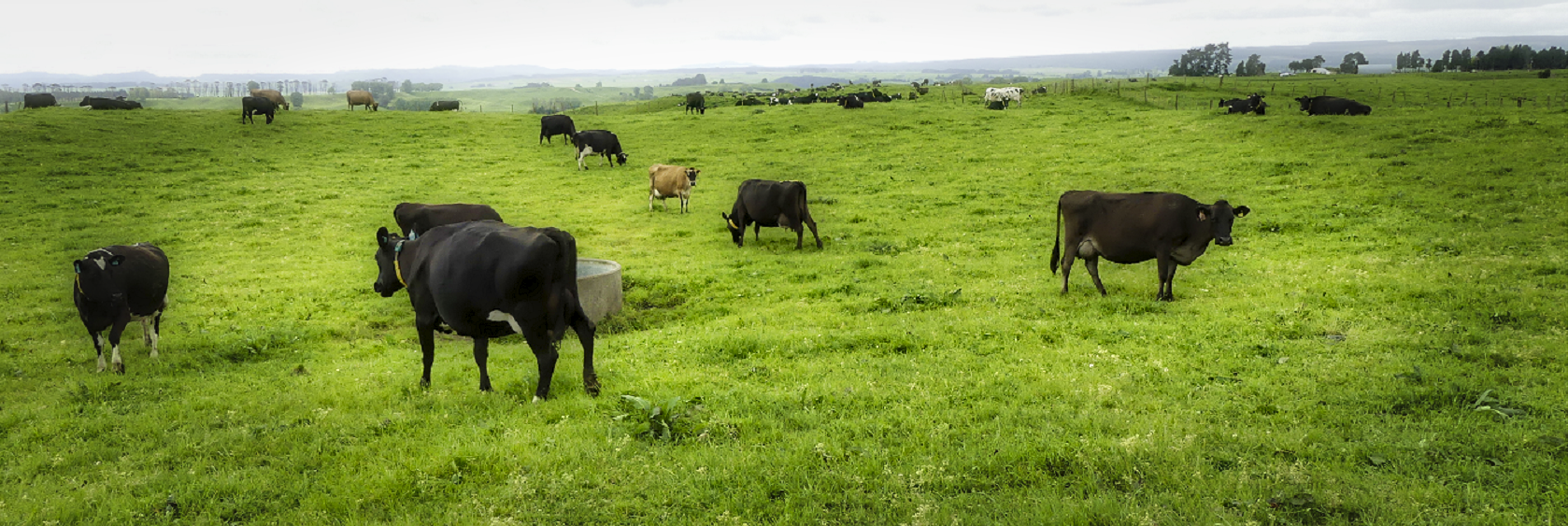
Temperate Grasslands can be found around the world in North & South America, Europe, Asia, Oceania and the cooler regions of Africa, in regions with moderate rainfall, seasonal variations in temperature, and a mix of wet and dry periods, typically, on flat to rolling land, river basins and low lying areas. Their fertile soils support dense productive grasslands like the perennial ryegrass/white clover (lolium perenne/trifolium repens) dominant intensive dairying pastures found in New Zealand.
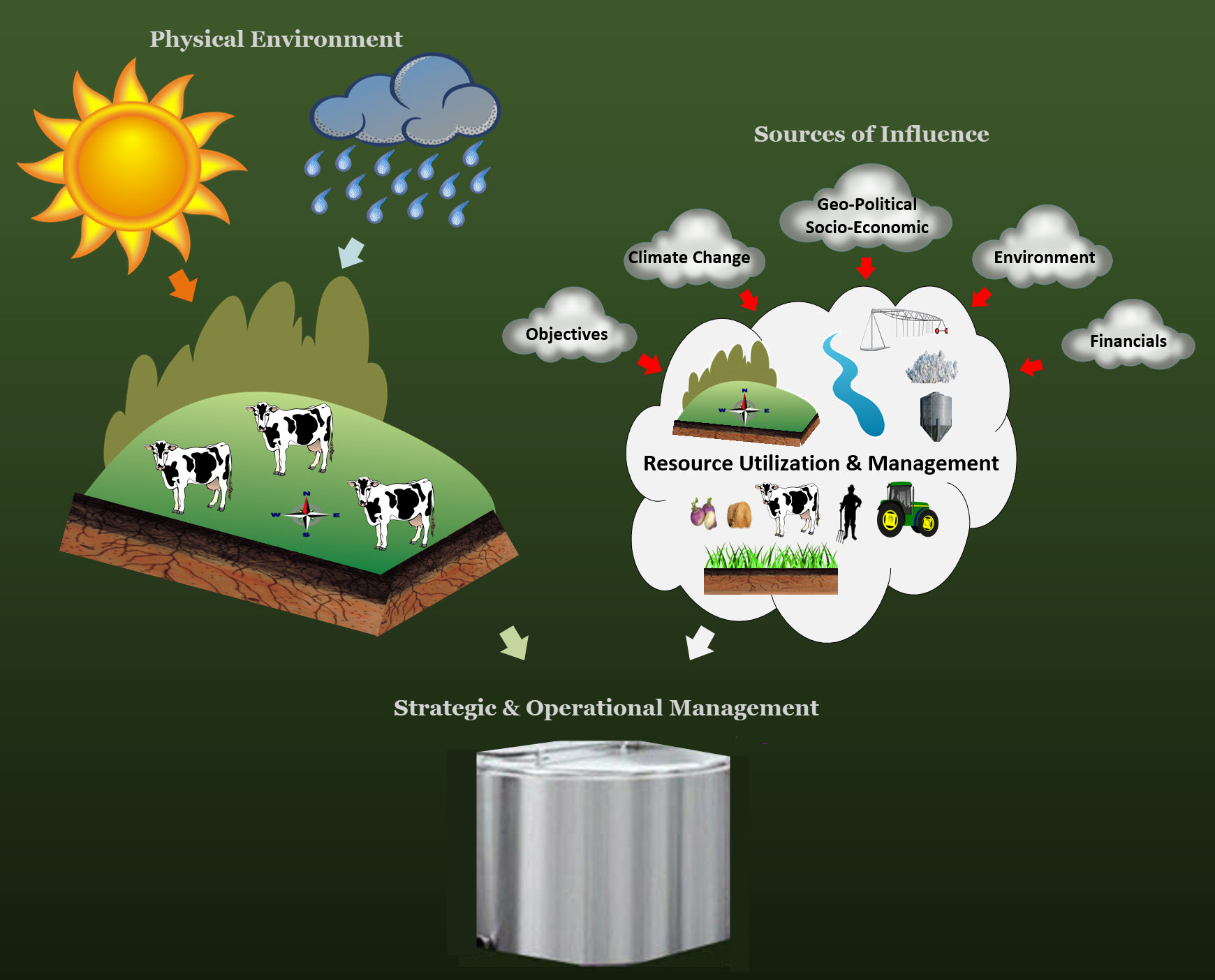
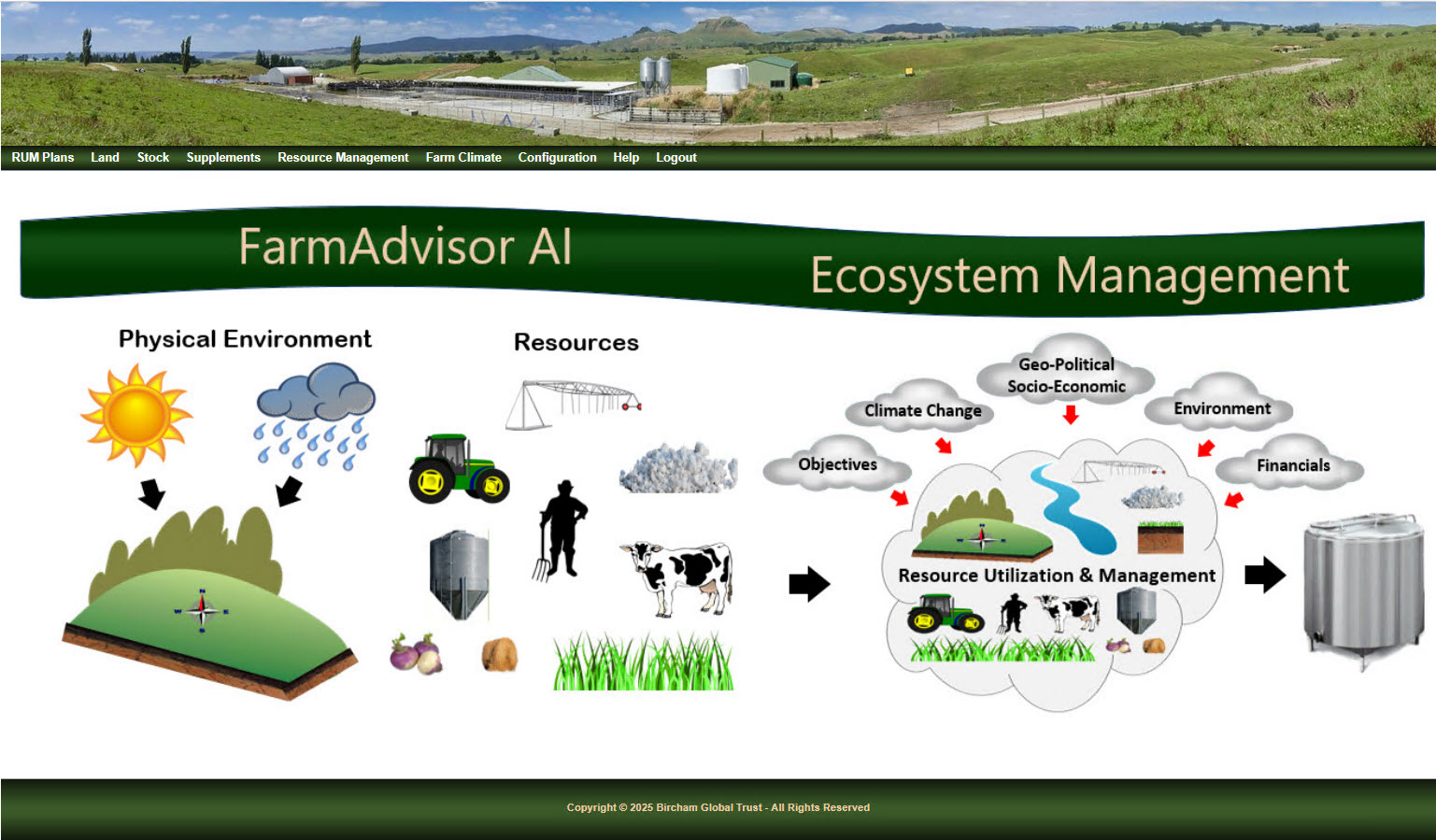
A Temperate Region Pastoral Dairy Ecosystem comprises grasses, legumes, shrubs, etc., soil fauna and flora and grazing herbivores, all embedded in a Physical Environment that in turn comprises the local climate, land form (aspect & slope) and soils. When actively farmed, the productivity of a pastoral ecosystem is the outworking the prevailing Physical Environment and the way in which resources are utilized and managed, not forgetting the influence (impact) of external influences, irrespective of the source, on the use and management of resources; i.e. water, land use , fertilizer, etc. consents and restraints.
What is FarmAdvisor AI?
Very simply, it is a Temperate Region Pastoral Dairying "Farm Management System" (FMS) that tracks the past performance of a Pastoral Dairying Ecosystem and projects its likely future performance based on prescribed (expected) climate, resource utilization and management. Its focus is upon ensuring the "Adequacy of Provisioning" both in the now and in the future, without which the achievement of Production Objectives may well be jeopardized.
Metaphorically, it is the equivalent of a modern aircraft's "Flight Management System" (FMS), an Expert System that automates many aircraft systems and in-flight tasks, including navigation and route planning. It also monitors and optimizes aircraft performance and provides an aircraft's crew with guidance on likely future aircraft performance, basing its projections on performance to-date, expected weather for the remainder of a flight, air traffic control directives, etc..
In modern aircraft, the FMS acts as a sophisticated digital crew member, performing the routine, repeatable, and calculable functions of both a "Copilot" and a "Flight Engineer." But it does not replace human intuition, judgment, or collaboration, especially in non-normal or emergency situations.
Likewise,FarmAdvisor AI's FMS (Farm Management System), is also an Expert System, a "Digital Copilot" that not only tracks and monitors the overall (past & present) performance of a Pastoral Ecosystem, but which also projects its likely future performance and the day-to-day operational provisioning and resourcing that will be required.
Its primary objective is not to predict outcomes with false certainty, but to create situational awareness and foreknowledge of the potential for "Known Unknowns", whether climate, supply chain, regulation, etc. or "Unknown Unknowns" (extreme climate events, unexpected geo-political disruptions or opportunities, etc.), to emerge in the future.
Moreover, it is not only a Pastoral Dairy Owner, Farm Manager or Worker's "Copilot", it is also a Farm Training Simulator and a Research Assistant; i.e. it can be used in a "Trial & Error" way to not only train, but to also explore, review and evaluate ideas, strategies, circumstances, situations and events, no matter how way-out they may seem to be. Moreover, failure to achieve a training objective or that a potential strategy just won't work, has no cost except that of a wounded ego. Indeed it has an upside, which is that while "luck" can sometimes be the key to success, more often than not it stems from failure and the subsequent forming of new mental beliefs and patterns.
It also has the capability to "shed light" on past and current situations and circumstances, to understand how and why things are the way they actually are, what happened, what did I miss, etc.? In such circumstances, the FMS underpins learning, not abstract process-based learning, but experientially-based learning that reinforces memory patterns and engenders confidence in future decision-making.
Risk, which in the ISO 31000 Risk Management Standard, is defined as the "Effect of Uncertainty on Objectives" is embedded in FarmAdvisor AI's FMS. Whenever there is a "Provisioning" threat to the achievement of objectives, whether actual or potential, it is flagged as a "Provisioning Shortfall - Feed Deficit"; i.e. a threat to the achievement of Production Objectives.

Aviation's "Flight Plan" & FarmAdvisor AI's "RUM Plan"
For many decades now, the Aviation Industry has required that a "Flight Plan" be lodged prior to flights in and through controlled airspace. FarmAdvisor AI's equivalent, is the RUM (Resource Utilization & Management) Plan.
Both are Statements of Intent, which when embedded into their respective FMS's, can guide an aircraft along its route (WayPoints & Flight Levels) to its destination or a pastoral dairy enterprise along its route (Farm Pasture Cover Path) to the achievement of its Production Objectives, through the four seasons of a year.
| Element | Flight Plan | RUM Plan |
|---|---|---|
| Objective | Fly To Destination | Milk/Milk Solids & Pasture Cover Objectives |
| PayLoad/Stock Nos. | Weight & Balance | Stock Nos: Milkers, Replacements, Etc. |
| Weather/Climate | Expected Enroute | Likely To Be Encountered Over 4 Seasons |
| Route | WayPoints & Flight Levels | Farm Pasture Cover Path |
| Provisioning | Fuel: Inclusive of Contingency (Emergency) Provisioning | Stock Feed: Pasture & Supplements Inclusive of Contingency Provisioning |
| Contingency Provisions Risk & Resilience |
Return to Point of Departure - Alternate Destinations | Supplements, Flexible Milking, Drying-Off, Destocking - Culling, Grazing Off... |
FarmAdvisor AI's "FMS" can represent the likely future provisioning capability and performance of a pastoral ecosystem for a prescribed climate (rainfall, radiation & temperature) regime and resource utilization and management program. It does not, however, have the capability to actually predict future local climate patterns (rainfall and temperature), or the way in which they will emerge and unfold; that is the responsibility of the user, whether farm-owner, farm-manager, farm-worker, consultant or bank-manager.
But what it can do, is to represent the likely impacts and consequences of a projected future's prescribed climate, strategic and operational resource utilization and management, on both the provisioning capability and performance of a pastoral ecosystem. It bears repeating that, FarmAdvisor AI's "Copilot" can foreshadow the impacts and consequences of emerging, whether actual or potential, geo-political, socio-economic, climate-change or environment protection influences and regulation. It has the capability to simulate and represent likely impacts and consequences of a wide range of both benign and adverse circumstances and events on the productivity and profitability of a Pastoral Dairy Enterprise.
It's focus: "Adequacy of Provisioning" - "Achievement of Objectives" - "The Future - Not the Past."
Moreover, when the inevitable departure from expectations or the 'norm' occurs, regardless of the reason or cause, FarmAdvisor AI has the capability for "Trial & Error" scenario innovation, evaluation, quantification, etc.: i.e. alternative ways of utilizing and managing available and other resources, to mitigate the impacts and consequences of adverse events and circumstances.
The RUM Plan: Strategic/Operational Guide & "AI Prompt/Query"
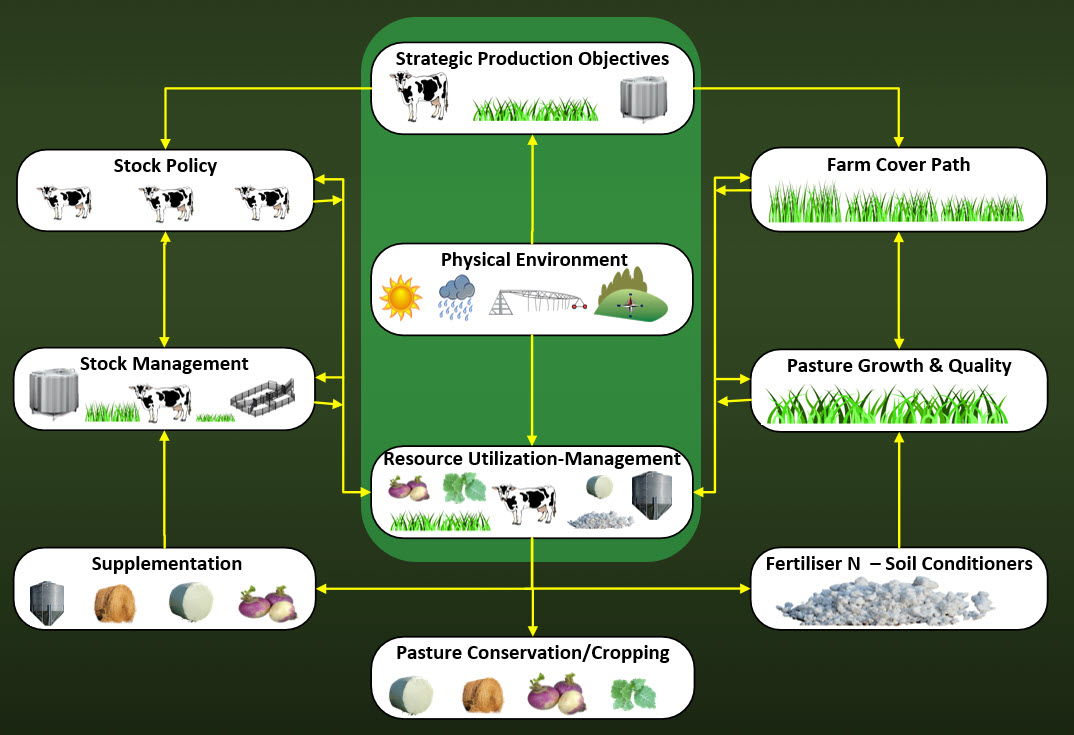
Central to FarmAdvisor AI's RUM (Resource Utilization & Management) Plan is the "Physical Environment", and in particular its Local Climate component, which both enables and constrains the performance of the Pastoral Ecosystems embedded in it, over the course of the four seasons of a production year. This ensures that RUM Plan projections not only pertain to and represent a pastoral dairy enterprise's production objectives, resource utilization and management, but also the uniqueness (land form, soils & local climate) of its Physical Environment and the Pastoral Ecosystems embedded in it.
Production Objectives (Milk Solids & Farm Cover Path), resource (stock, pasture, crops, supplements, fertilizer, irrigation, etc.) utilization and management are all embedded into a RUM plan that unfolds each day for a year.
In FarmAdvisor AI's FMS, a RUM Plan is the equivalent of a natural language Generative AI prompt/query; i.e. it is both a plan and a query, which when executed, delivers outcomes, not a set of recommendations. This is what is likely to happen, the impacts and consequences of an outcome, which the user can then review and interpret using a comparative reference standard, their own knowledge and experience and/or that of others.
Provisioning Guidance: Strategic & Operational Planning
To view the detail of the next three graphics, it may be necessary to activate the "Zoom" option on your browser or device to view. Each of these graphics has four sections:
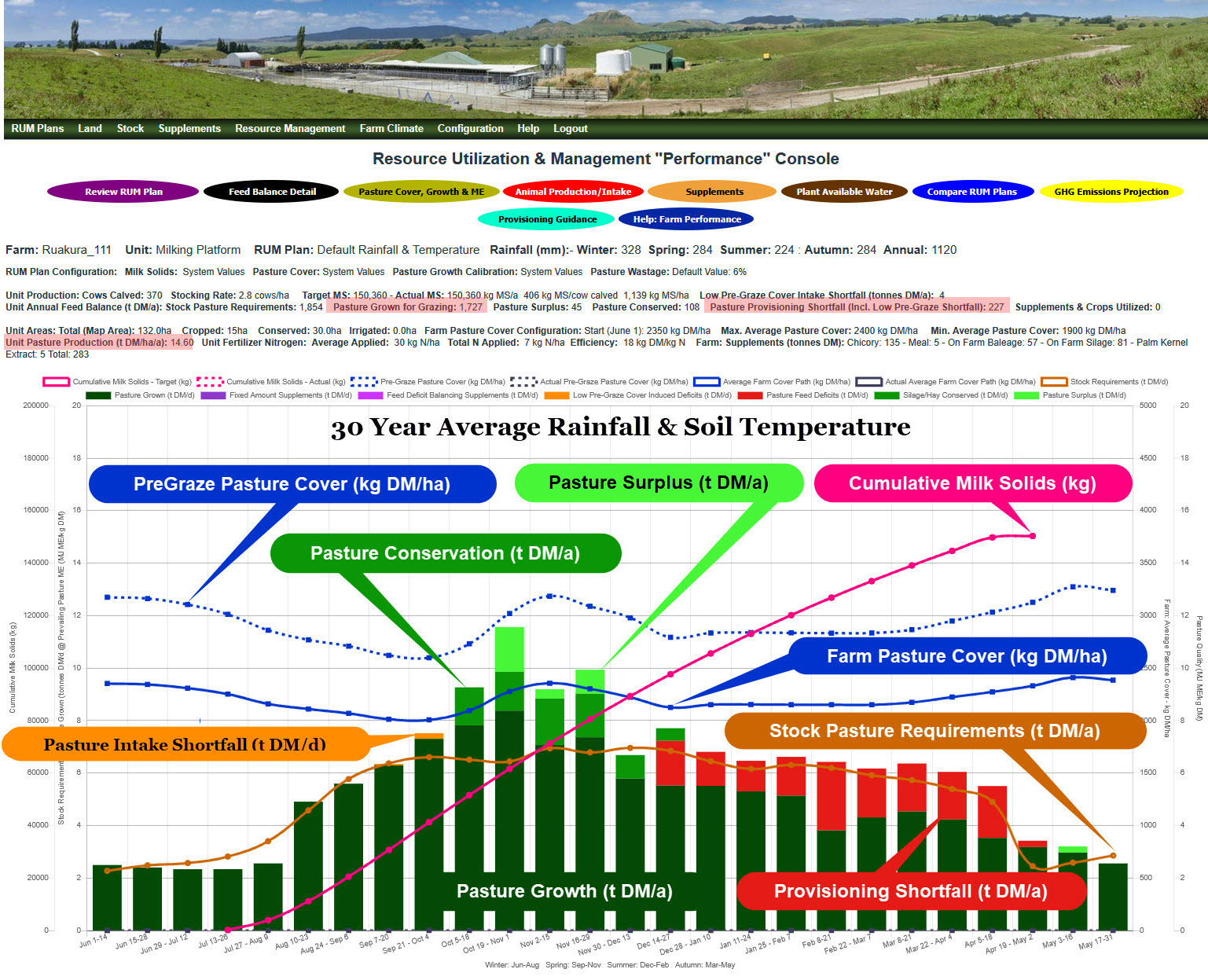
The annotations in the above graphic, with the exception of "Pasture Intake Shortfall", are self-explanatory. This annotation has its origins in the grazing behaviour (bite size, rate of biting and the duration of grazing activity) of dairy cattle.
To achieve pasture intakes of 16-18 kg DM, Pregraze Pasture Covers of between 2800 & 3200 for perennial ryegrass/white clover pastures are generally recommended, which loosely translate to average pasture covers of the order of 2150 to 2350 kg DM/ha. The primary reason for this recommendation, is the reducing bite size of grazing dairy cattle as pasture cover diminishes when break feeding. Other factors, including a herd's social order with older cows often dominating younger animals at the grazing interface, heat stress, etc. can also influence grazing behaviour; i.e. rate of biting and time spent grazing, etc..
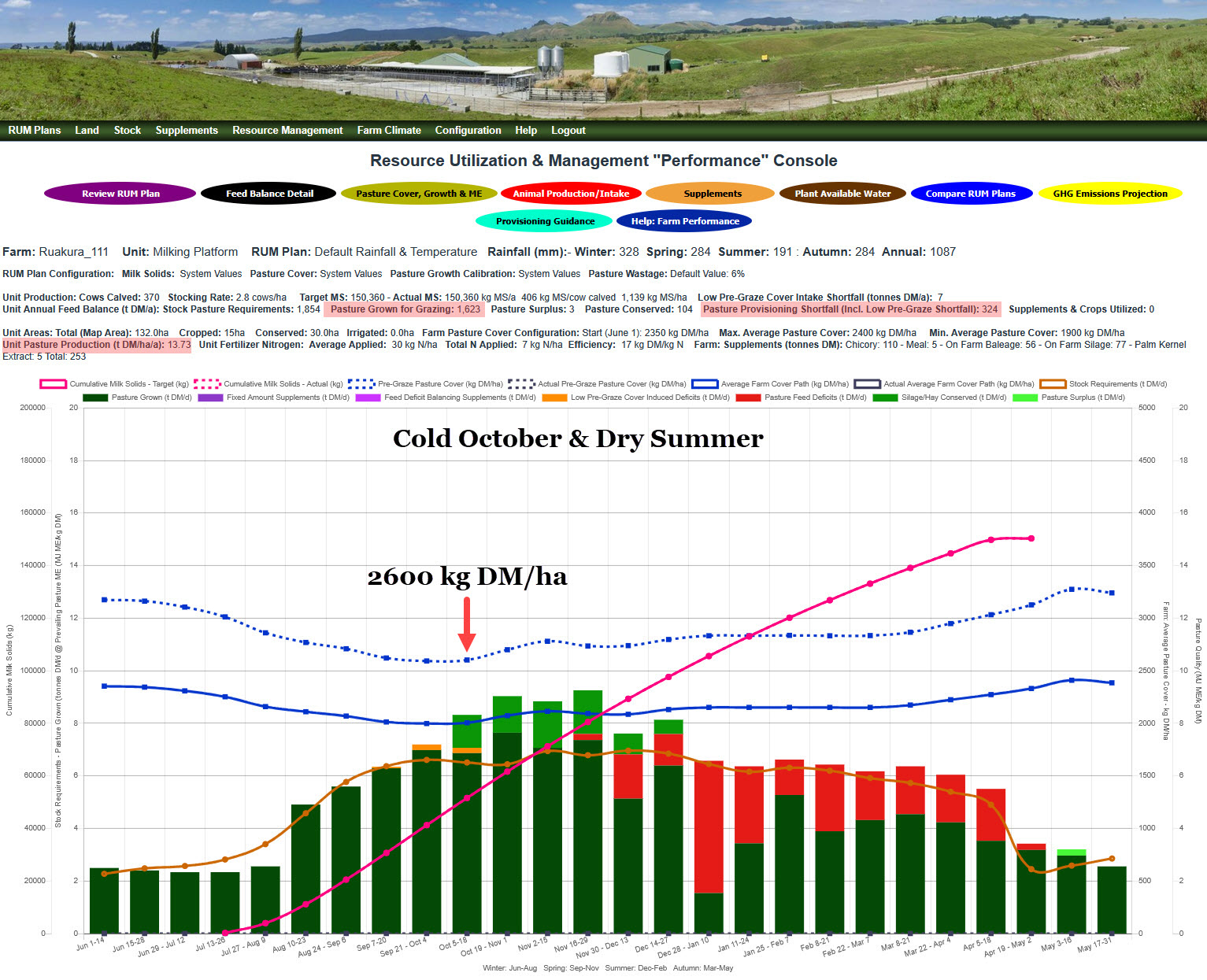
In FarmAdvisor AI's FMS, "Pasture Intake Shortfalls", the outcome of less than optimal bite size, are triggered when "PreGraze Pasture Covers" during lactation are less than 2600 kg DM/ha; (see above graphic).
In the above "30 Year Average" example, the "Pasture Provisioning Shortfall" is 227 tonnes of pasture dry matter. When a cold October is introduced, followed by a dry summer (33 mm less rain over the three months of summer, including two consecutive weeks without rain in late December-early January), the "Pasture Provisioning Shortfall" increases by 97 tonnes of pasture dry matter to 324 tonnes (see graphic below). Note also, the reduction in the amount of pasture grown for grazing - 104 tonnes DM.
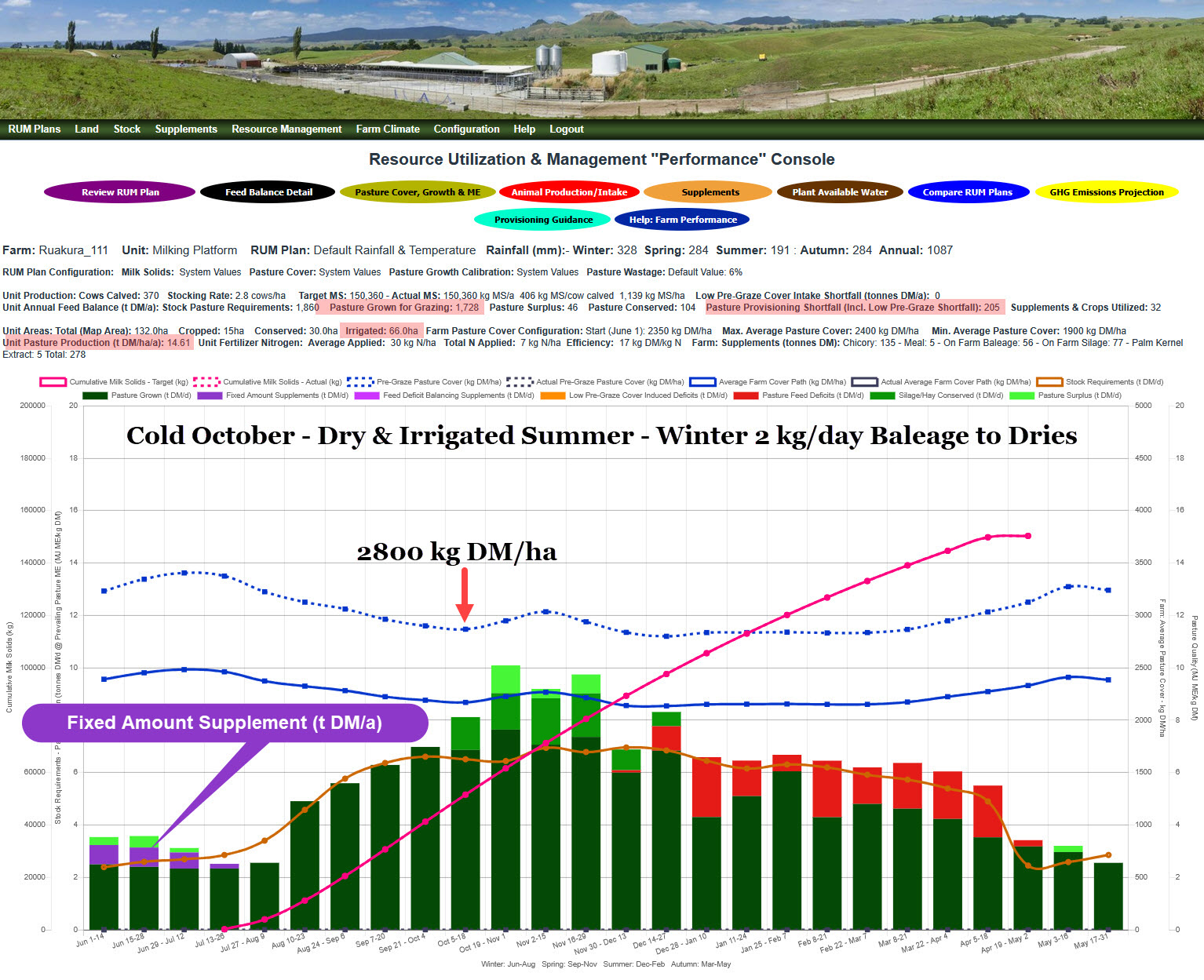
The third graphic (see below) illustrates the way in which supplement and irrigation resources can be utilized. In this example a supplement is fed to the Dries for 7 weeks prior to the commencement of calving with the view to ensuring Pregraze Pasture Covers are greater than 2800 kg DM/ha during the peak lactation period of a spring calving herd. Irrigation over half of the Milking Unit commenced in early December and continued through until the end of April, increasing the amount of pasture grown during the summer and autumn period, and at the same time reducing the overall Provisioning Shortfall.
Provisioning Guidance: Day-To-Day Pasture & Supplement Allocation
"Provisioning Guidance" is based upon the information generated in the "RUM Plan" that precedes the use of this module. Its objectives are very simply:
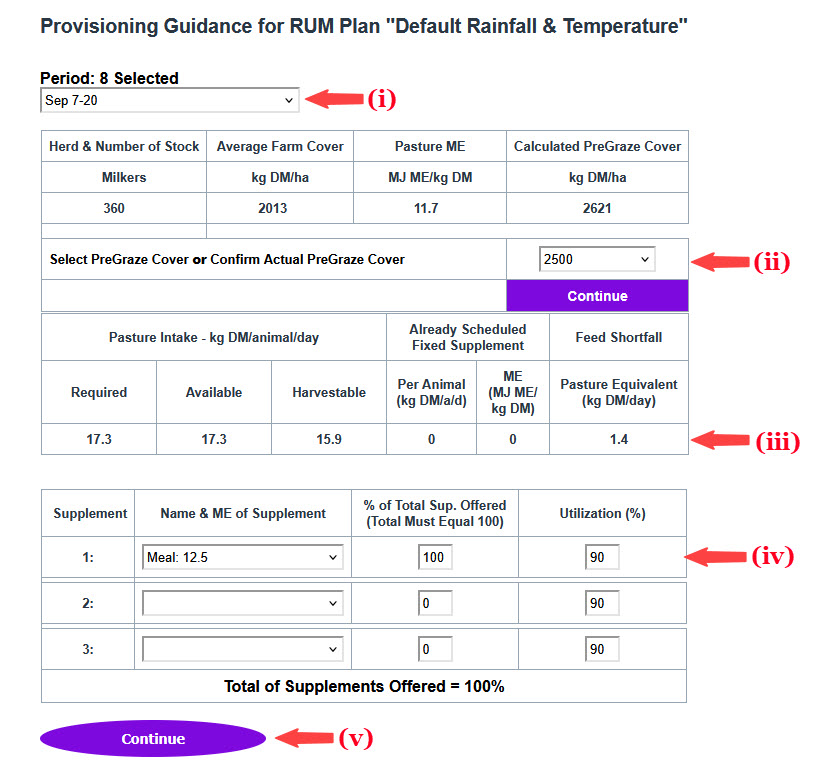
| Step | Description |
| i | Selecting the "Period" will populate the Herd (name and number of stock), Average Pasture Cover, ME of the pasture and the Calculated PreGraze Pasture Cover. |
| ii | Initially, the selected "PreGraze Cover" will be the "Calculated PreGraze Pasture Cover", but this can be changed by selecting the "Pasture Cover" of the area of pasture to be grazed by the herd. |
| iii | The pasture Intake of a grazing dairy cow is defined in three ways: (a) The amount she requires to meet her milk solids production, live-weight and pregnancy objectives; (b) The amount of pasture that is actually available for grazing; and (c) The amount of pasture that she can actually harvest during the grazing period. If the herd is fed a fixed supplement as per the example in the previous section, then the "Required". "Available" and "Harvestable" intake values are adjusted accordingly and any "Provisioning (Feed) Shortfall" calculated. |
| iv | When there is a "Provisioning (Feed) Shortfall", a supplement or supplements must be defined together with their respective ME values and expected levels of utilization. |
| v | Press [Continue] to calculate pasture break sizes and the amount(s) of supplement required. |
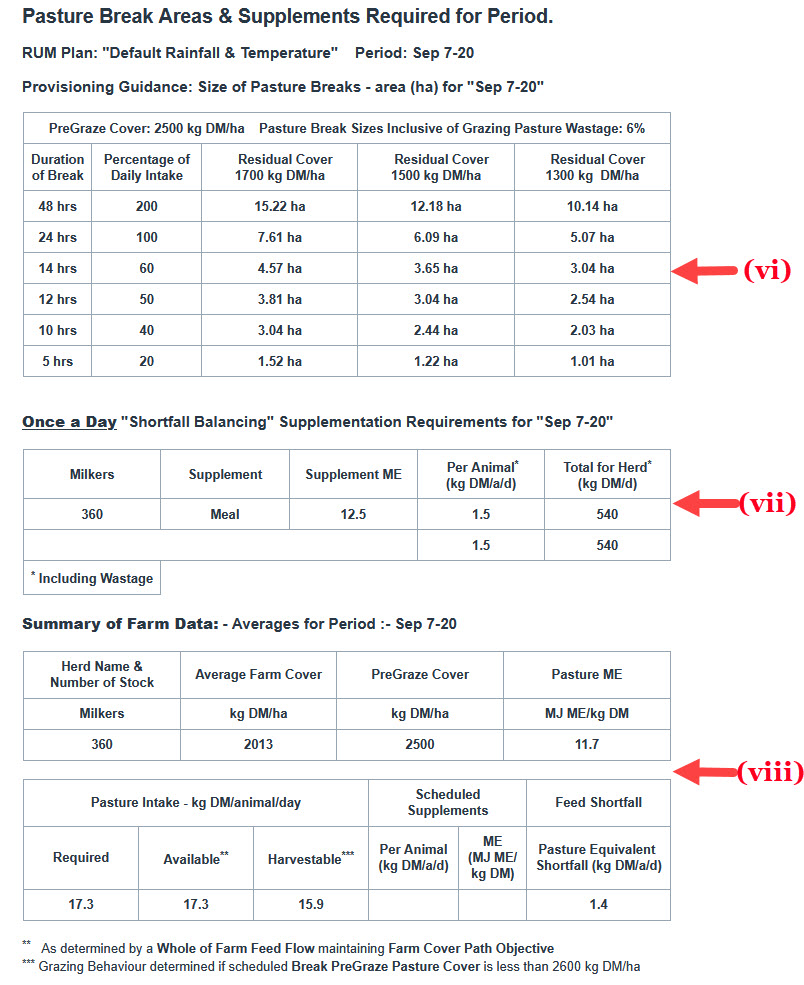
| vi | Pasture Break Sizes (hectares) for a range of grazing durations. |
| vii | Shortfall Balancing Supplementation requirements. |
| viii | Summary of information underpinning the "Provisioning Guidance" calculations and outcomes. |
Approach the Future With Confidence: Provisioning - The Key
"Adequacy of Provisioning" is the key to successful pastoral dairying in temperate grassland environments. Get it right and "Production Objectives" will be achieved.
It is the "Linchpin" that connects Local Climate, Harvestable Pasture/Supplements, Animal Feed Requirements and Production Outcomes. It also identifies potential shortfalls in Provisioning (i.e. a feed shortfall), that could jeopardize the achievement of both Production and Financial Objectives.
FarmAdvisor AI heralds a new, yet old and also pragmatic way of pastoral management and ongoing provisioning, that is not only robust, but which also aligns well with collar-based "Virtual Fencing" technology. It simplifies everyday grazing management decision-making to a step-by-step data-focused, by the numbers process. Moreover, it removes the need to actively manage rotation length, spring rotation length, etc. because they are all embedded implicitly in a Resource Utilization & Management (RUM) Plan that includes a "Farm Cover Path" (aka the Intended Flight Path detailed in a Flight Plan), all of which can be managed (adjusted) to reflect the realities of the seasons as they emerge and unfold.
It has the capability to not only guide current Resource Utilization & Management Actions and Decision-Making, but to also underpin them with "Future Analytics" gained knowledge and understanding; i.e. the many ways in which a pastoral ecosystem can respond to projected future local climate and resource utilization & management regimes, not forgetting impending or potential geo-political, socio-economic, environmental influences, regulation, etc..
FarmAdvisor AI is more than just another App that seeks to project future outcomes with false certainty. It is a "Living Operational Model" that records not only a Pastoral Dairy Enterprise's past and current performance, but also actively navigates it toward where it needs to go, equipping farm owners, managers and workers with the experiential knowledge they require to manage climate, socio-economic, geo-political, etc. uncertainty with confidence, to optimize outcomes and to build resilience into their enterprise..
In summary, FarmAdvisor AI is an "Artificial Intelligence" product for "Pastoral Dairying". Like "Generative AI" products (Copilot, ChatGPT, etc.), it can respond to prompts or questions. However, whereas Generative AI products respond with comment, recommendations and suggestions, FarmAdvisor AI responds with outcomes, impacts and consequences that pertain to the Physical Environment in which Pastoral Ecosystems are embedded, and the way in which associated resources are utilized and managed. It's "RUM" (Resource Utilization & Management) Plan (equivalent of Generative AI's prompts) provides the background context to prompts, questions, "What Ifs", etc. like:
It's Different - Like to Know More - Drop Us a Line - We'll Arrange a Demo